Dyslexia Symptoms
Quick Facts about Dyslexia Symptoms
- Classic dyslexia symptoms include slow reading, very poor spelling and weak phonemic awareness, resulting in great difficulty sounding out words — especially unfamiliar ones.
- Pre-school warning signs include delayed speech, difficulty learning the alphabet, inability to rhyme words, confusion of left & right, before and after and other directional or relational words, poor pencil grip and messy writing.
- Symptoms can be seen as early as the first six months of age.
- Difficulty tying shoe laces and reading a clock with hands are reliable indicators of dyslexia.
- Reading problems are often unexpected relative to other cognitive abilities or skills.
- Dyslexia varies from mild to severe, with symptoms varying in degree and number accordingly.
- It often co-exists with ADHD, dysgraphia, dyscalculia and dyspraxia.

Overview
The symptoms of dyslexia may surprise you. They include difficulty reading but also difficulty tying shoe laces, difficulty making rhymes and being late in establishing a dominant hand. Though these are mostly indirect indicators of dyslexia, they are also among the most reliable.
Still, one should always proceed cautiously in trying to identify dyslexia, because it ranges in strength from mild to severe and symptoms can vary significantly from person to person. Further, a lack of exposure to reading and words can mimic dyslexia.
The first indicators of dyslexia usually appear long before the first lesson on the ABCs. Our list of dyslexia warning signs below is arranged by the developmental age at which they can first be seen. Yes, you can know very early — so don't let anyone tell you to delay testing.
Dyslexia Symptoms by Age
Preschool Dyslexia Symptoms (0–4 years)
- Family history of reading difficulty
- Early childhood ear infections
- Delayed speech
- Difficulty memorizing the alphabet
- Delayed establishing of a dominant hand
- Difficulty with sound pronunciation
Dyslexia may skip a generation and never have been diagnosed, but it remains highly heritable. If you have it, there is approximately a 50% chance your child will. Dig carefully through your family tree before concluding it's not there. Many adults hide their reading difficulty or chose careers that did not require reading — something increasingly difficult to do.
Did your child suffer from recurring ear infections as an infant or when they were very young? The ear infections themselves may not be the cause, but they may relate to why dyslexia is an auditory disability more than a visual one. Learning of this odd indicator was an eye opener for us, because my stepson had a history of ear infections as a baby — just another warning sign of which we were not aware. Note that some research in this area has found no correlation between the infections and dyslexia, but study continues.
Distinguishing and manipulating the fundamental sounds of language is very difficult for people with dyslexia, so it's no surprise they may be late in developing speech. Every child learns at his or her own pace, so don't jump to conclusions if your child is behind “the norm”. According to the Mayo Clinic:
By 3 months: your child might make “cooing” sounds, seem to recognize your voice and cry differently for different needs.
By 6 months: babble and make a variety of sounds, use his or her voice to express pleasure and displeasure and pay attention to music.
By 12 months: imitate words, say a few words such as “yes”, “no”, “mama” and “uh-oh”, recognize words for common items, such as shoe.
By 18 months: may identify familiar objects and people.
By 24 months: may have a vocabulary of about 15 words and use two-word sentences.
Children typically learn the alphabet between 3–5 years of age, but a child with dyslexia may struggle well beyond those ages to achieve mastery — and even then may forget the sequence from lack of practice. Extra repetitions alone may not be enough; alternative multisensory methods of teaching the ABCs may be required.
For most kids, a hand preference emerges between 2–4 years of age and is established by age 5. People with dyslexia usually take longer. Note that people with dyslexia are more likely to be left handed than those in the general population, but being left handed does not cause dyslexia.
Here we are talking not about words but the 44 specific phonemes (sounds) of the English language. For example, difficulty with the /th/ and /r/ sounds is very common. This problem is normal for all younger children, but is more pronounced in children with dyslexia. If weak pronunciation persists it can reflect an auditory processing problem wherein some sounds are simply not being distinguished properly by the brain. If you suspect problems, consider asking your school for support from a speech-language pathologist. In Canada, if the school doesn't provide such a service, check with SAC Canada.
Elementary School Dyslexia Symptoms (5–12 years)
- Difficulty pronouncing multi-syllable words
- Dysgraphia
- Letter and word reversals in writing
- Poor reading ability
- Poor spelling ability
- Difficulty with math
- Difficulty telling time on a clock with hands
- Difficulty learning to tie shoes
- Difficulty with cursive writing
- Inability to rhyme
- Struggles to find the right words when speaking
- Struggles with directions
- Can't remember their phone number or address
- Difficulty being organized
- Lower self-esteem
Difficulty with the basic sounds (phonemes) of language is the signature difficulty of the dyslexic. Very simply, the more sounds and syllables in a word, the more likely a child with dyslexia will have trouble pronouncing it. The order of the sounds tends to get jumbled, thus “pasghetti” (spaghetti) and “Kershmal” (commercial). Be careful with this symptom though, because it's quite normal for kids to mash up words when first learning them. The child with dyslexia simply has a more acute problem and it doesn't resolve as easily. In fact, it will never completely go away.
Children with dyslexia often have dysgraphia, which means difficulty writing. It is not simply messy handwriting, although messy writing and difficulty staying between lines are typical. The problem is rooted in weak fine motor skills combined with difficulty memorizing sequences, since drawing each letter is a sequence of pencil strokes. Signs to watch for include poor pencil grip and moving the wrist or arm (gross motor skill) instead of the fingers (fine motor skill). Read more on our dysgraphia page.
Yes, the stereotype contains a kernel of truth. For those with dyslexia, 'pat' may become 'tap' or 'bat' may become 'pat'. All kids will occasionally reverse letters as they learn to write, and everyone makes mistakes when they are tired or not focusing. The difference with dyslexia is that the problem may be more persistent and continue beyond grade two or three.
Reading will tend to be very slow and labored and, in some cases, you may note odd guesses at words based solely on context or word shape. Some with dyslexia tend to see words holistically and thus “witch” and “watch” become almost indistinguishable, as the beginnings and ends are the same and the words have the same number of letters. This is the reason that phonemic awareness is a prerequisite for reading. If students cannot mentally break larger words down into syllables, they can become overwhelmed when faced with multi-syllabic words.
Spelling will be very difficult, especially words that have more syllables in them and irregular words such as 'yacht' or 'enough'. Spelling rules will need to be taught explicitly for real progress to be made. On a positive note, with spell check, speech-to-text technology and predictive typing, spelling is somewhat less important as a critical writing skill today.
Many people with dyslexia have difficulty with mathematics due to working memory and sequential processing weaknesses, as well as difficulties with rote memorization (see dyscalculia). Algebra may be challenging given its language-like sequencing of letters and numbers. Similarly, word problems (e.g. “Sally had three times as many pens as Sam…”) may become opaque not because of mathematical deficiency but simply from poor comprehension of the question.

At first it may seem inexplicable, but the inability to tell time on clocks with hands is very common among children with dyslexia. This may result from prepositional confusion (before/after) or directional confusion (left, right), which in turn reflects a problem with sequencing and ordering of things. The sequencing of space or time is perhaps not so different a mental task from the sequencing of sounds.

It may seem so simple, but tying knots of any kind involves an abstract sequence of steps — and that means trouble for most children with dyslexia. Stick with Velcro — seriously. Difficulty tying shoe laces is a reliable sign of dyslexia.
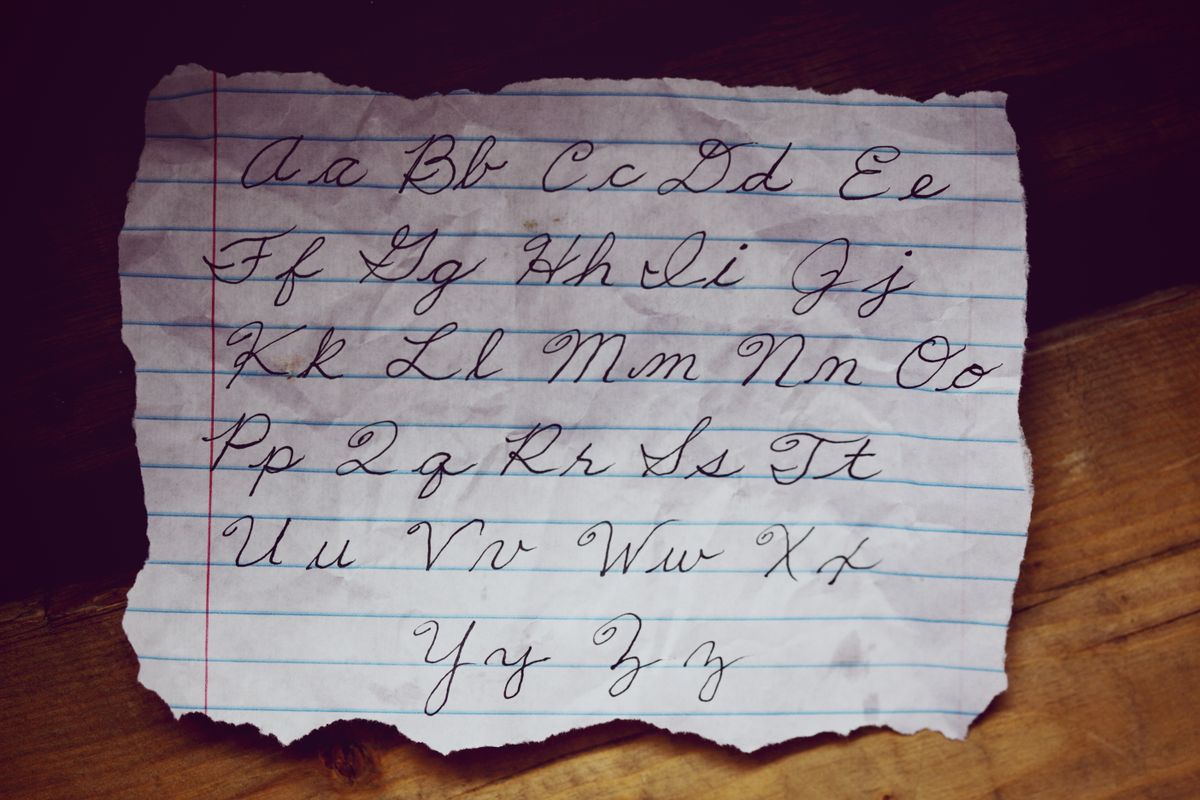
If your child struggled with basic letter formations (print), they will likely struggle with cursive writing. This may result from a tendency to see words as whole shapes or objects, and therefore cursive text can appear visually overwhelming. Alternative teaching methods can help overcome this barrier. There are two schools of thought on teaching cursive writing to children with dyslexia who struggled with print: some feel that it should be avoided; others think that it presents an excellent opportunity for developing fine motor skills, concentration, speed of writing and, of course, penmanship.
When you first witness this, it's completely bewildering. Rhyming seems so easy for people without dyslexia because it simply involves swapping out one sound (phoneme) for another. But children with dyslexia just cannot parse (break and reassemble) words in that way. This is one of the more reliable indicators of dyslexia because it requires a very specific ability that a person who actually has dyslexia struggles with: phoneme manipulation. If I had to choose one indicator to quickly identify dyslexia, it would be the ability (or not) to effortlessly rhyme words.
You may notice lots of “ums” and “ahs” and “that thing-a-ma-jig over that way” kind of sentences. This is likely a result of difficulty with word recall and difficulty recounting events and stories, in part because sentences and stories are sequences that have to be assembled in a more or less specific order.
Left/right, east/west, before/after, in front of/behind are all difficult abstractions for children with dyslexia. The term directional dyslexia is sometimes used to describe this problem.
Addresses and phone numbers seem like short and easy things to recall, but they are abstract sequences of information not used often. Without repeated practice, it's information easily forgotten.

Lots of kids are messy, but children with dyslexia have an especially hard time keeping things tidy — from their bedrooms and closets to their school bags and lockers. Be patient and try to provide helpful direction and advice. Do not say “clean up your room” because she won't know all the steps to get there; instead try just the first step: “put all the dirty clothes in the hamper.” Provide one step at a time and reward them for every success.
Daily failure in the public eye and in the presence of your peers will quickly take a toll if not offset by a lot of encouragement and positives. Ben Foss coined the term 'slow drip trauma' to describe the daily stress and anxiety that people with dyslexia often have to bear. I think it captures the seriousness of the problem. Be sure to recognize and celebrate every success. Find your child's strengths and be sure they spend lots of time on those activities — sports, art, music, drama, dance, even video games. Everyone is good at something.
Young Adult Dyslexia Symptoms (13–17 years)
Many of the childhood dyslexia symptoms persist into adulthood, but other signs also hint at dyslexia.
- Poor grades despite considerable effort
- Dislikes school & may drop out
Obviously poor grades can result from many things, but for those who suffered from a reading deficit as a young child, academic problems begin to compound. Without the right kinds of interventions at home and in the classroom, even twice the homework and private tutoring may not turn marks around.
For many people with dyslexia, school is a place associated with failure, so by high school we should not be surprised they are looking for an exit and drop out. People with dyslexia make up a disproportionate number of creative entrepreneurs who start their own companies — Richard Branson is the perfect example. Sadly, people with dyslexia also make up a disproportionate number of inmates who never found their place in the world.
Adult Dyslexia Symptoms (18+ years)
Many of the childhood and young adult symptoms continue, but now the signs are more like consequences.
- Avoids reading or hides disability
- Underemployed
- Reading and writing remain difficult
Without proper help, reading and writing are simply avoided as much as possible — a source of shame or embarrassment.
Adults with dyslexia may be found in lower-skill jobs than expected when overall intelligence and capabilities are considered. People with dyslexia often thrive in “people” jobs such as sales, or as artists, architects, cooks and in the skilled trades.
Books and reading fail to become a source of joy or pleasure. If never introduced to audio books or speech-to-text technology, adults can remain cut off from many sources of information and entertainment that most other adults take for granted.

Final Thoughts on Dyslexia Symptoms
Many people live their entire lives never knowing they have dyslexia, slowly convinced that they are less than what they really are. If you see the signs and symptoms listed here in a child, a student or an adult friend, then please utter three little words: “Maybe it's dyslexia.” It's best to say it out loud.
Good Luck and Good Reading!
- Home ›
- Dyslexia Symptoms